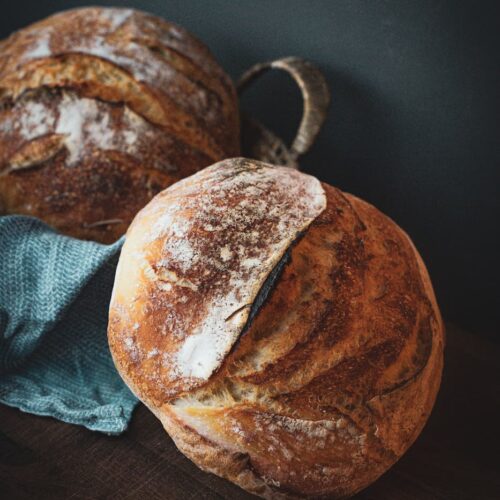
Everyday Sourdough
Everyday sourdough is a simple, homemade bread made with a sourdough starter instead of commercial yeast. It is perfect for beginners and busy bakers because it uses basic ingredients and an easy process. With a crisp crust, soft interior, and rich flavor, it is a great bread to make regularly for sandwiches, toast, or serving with meals.
Ingredients
Everyday Sourdough - Ingredients
- 240 g active starter
- 425 g water
- 600 g flour
- 2 tsp salt
- Rice Flour for dusting the proofing basket optional, helps dough not stick to proofing basket
Instructions
Mix
- Pour the starter and water into your mixing bowl, and mix to dissolve the starter into the water. Add flour and mix until a shaggy and rough ball is formed. This is a very sticky dough, I start with a danish dough whisk then eventually use my hands.
Autolyse — 30 minutes
- Cover and let the bowl rest for 30 minutes.
- The flour will absorb all the water, the gluten will come together, and the dough will become more smooth and more manageable.
Salt + Knead
- Add your salt and begin to knead until your dough becomes cohesive and a bit springy. The dough will firm up from the salt but it should still be slightly tacky.
Bulk Fermentation — 6 to 12 hours
- Shape loosely into a ball, cover the bowl, and let it rise about 50%. You're looking for the dough to noticeably puff up and pull away slightly from the sides of the bowl, with bubbles showing on the surface and sides. It should feel airy and alive, not doubled — you still want some tension left in it for shaping.
- I know 6-12 hours is a big range. This is because your kitchen's temperature, your starter's strength, and the humidity in the air all play a part. Pay attention to the dough, not the clock; experiment and find out what works for your starter and kitchen. If it seems noticeably larger and appears airy, and alive, it's ready. In Hawaii, I have left it to ferment outside and it took only 4 hours.
Shape
- Turn dough onto a floured surface and allow to rest 10 minutes uncovered. This helps to soften the gluten to shape easily.
- Gently pull the dough to stretch it into a rough rectangle, but avoid tearing it! Fold in each side toward the center like closing an envelope, then roll the bread up like a burrito. Pinch the sides then cup your hands around the dough and drag it in small circles against the counter to build a tight, smooth surface. Tight dough rises in the oven, loose dough spreads out flat.
Final Proof — 1.5 to 4 hours
- Cover and allow to rise until puffy and close to double the original amount. Same rules as before: observe, become familiar with surroundings. Use a proofing basket, if you have one. Otherwise a greased bowl will do the job.
- Press it gently with a floured finger: the indent should spring back slowly, not instantly.
Preheat
- About 30 minutes before your dough is ready to bake, place your empty Dutch oven with the lid on into the oven and set it to 500°F. Let it heat up together with the oven. You want the Dutch oven to be screaming hot by the time the dough goes in. The hot dutch oven is what traps the steam and gives sourdough its crackly crust and big oven spring.
Bake
- Place the boule dough on parchment or silicone bread baking mat. Score the top of your loaf, one bold cut down the center, or feel free to get fancy with it.
- Remove the dutch oven using oven mitts
- Use the handles of the bread mat or sides of the parchment paper to lift and place boule dough in Dutch oven
- Cover; bake at 500° F for 25 minutes
- Turn the oven to 400°F, open the lid, turn the pot around and bake for 12-15 minutes more.
- You want deep gold brown rather than light or pale.
Cool
- Remove and place on a wire rack.
- Now let it cool. Ideally two hours. The loaf is still baking on the inside while cooling down and if you slice it too early, even if the outside looks good the inside will remain gummy.
Tried this recipe?Let us know how it was!